
23.10.2026 –
14.02.2027
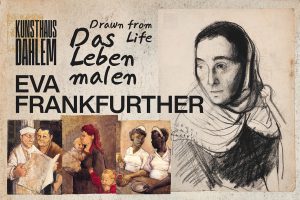
EVA FRANKFURTHER – Drawn from Life
- Eva Frankfurther’s life and work
- About the exhibition
- Exhibition catalogue
- Support
- Cooperation partners
Eva Frankfurther is among the most remarkable rediscoveries of postwar British art. At the heart of her work are people whose everyday lives were shaped by labour, migration and social insecurity: immigrants, manual workers and the residents of London’s East End. With profound empathy and a keen social awareness, she created portraits and studies of ordinary lives that vividly document these communities and remain strikingly relevant today.
Opening: 22 October 2026, 7 pm
Welcome remarks and introduction to the exhibition by Dr Dorothea Schöne, Artistic Director of Kunsthaus Dahlem, Ruth Ur, Director of Exilmuseum Berlin, and Sarah MacDougall, exhibition curator
Eva Frankfurther’s life and work
Eva Frankfurther was born on 10 February 1930 in Berlin-Dahlem, the youngest of three children of the textile manufacturer Paul Frankfurther and his wife Henriette, who died when Eva was a baby. The family belonged to the assimilated Jewish middle class. Following the Nazi seizure of power, they were forced into exile: in 1939, the children were sent first to England, and shortly afterwards her father and stepmother also succeeded in escaping Germany.
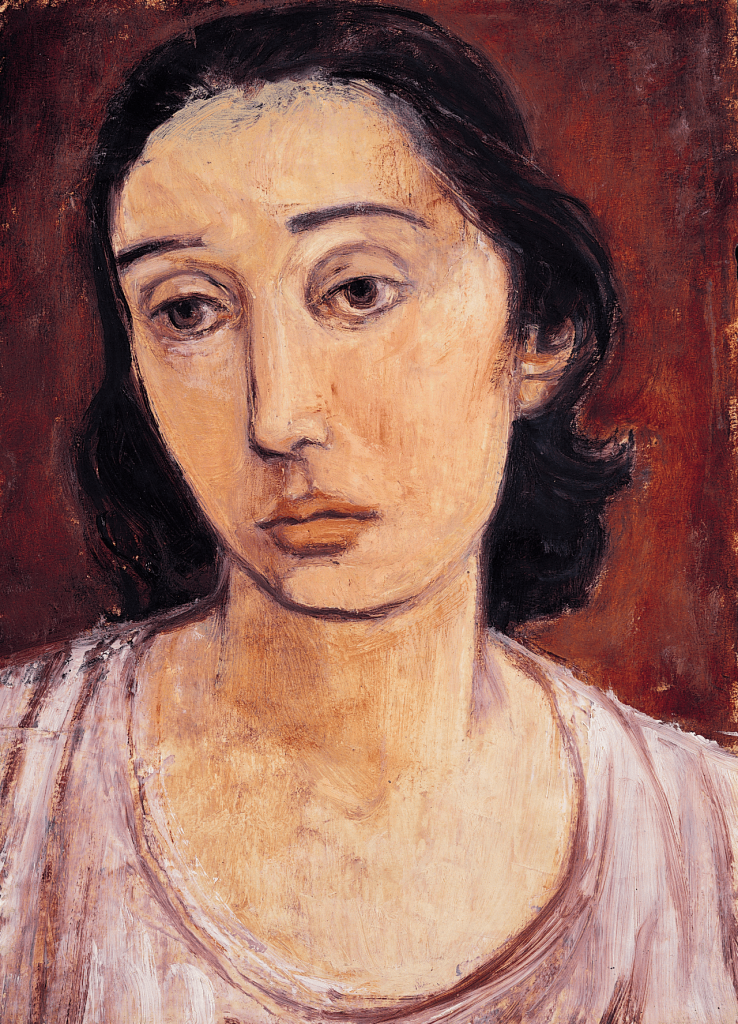
From 1946 to 1951, Eva Frankfurther studied at St Martin’s School of Art in London. She soon became disillusioned with the London art scene, where both teaching and exhibition practice were largely concerned with formal questions and the debate between figuration and abstraction. For Frankfurther, however, form and colour were never ends in themselves, but means of understanding and representing people and the social realities of their lives. Her encounters beyond the studio were formative. Between 1948 and 1950, Frankfurther travelled three times to the United States, where she taught art and crafts at the summer camp run by her aunt, Vera Lachmann. During these visits she also spent time in Harlem, New York, where she produced sensitive portraits and studies of the Black community – works that would become the foundation of her later artistic development.
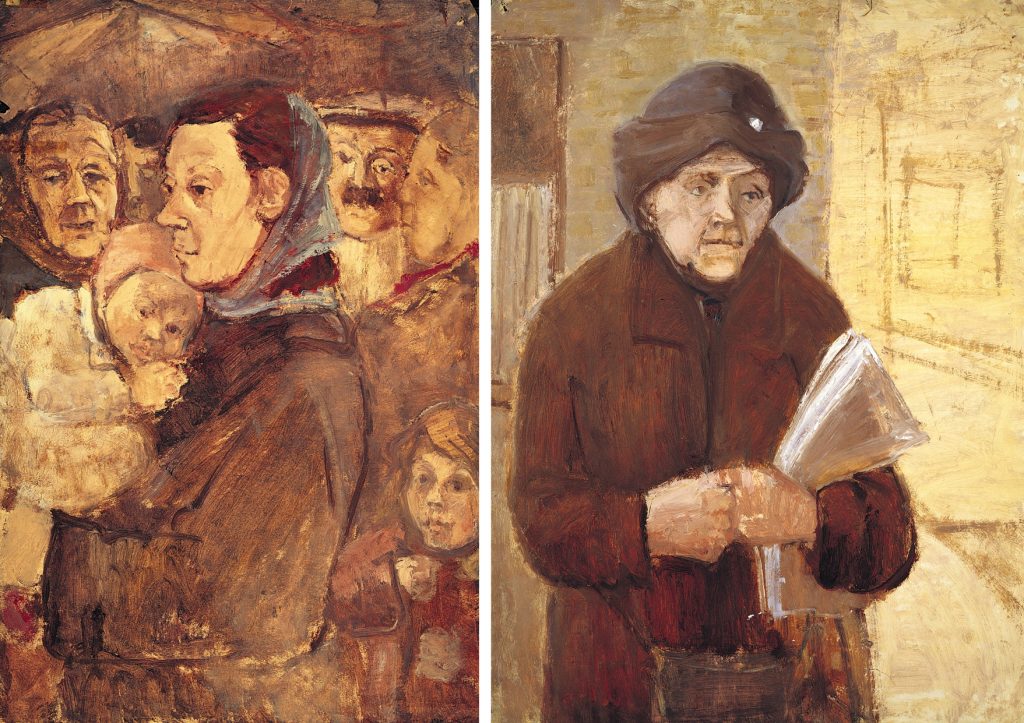
After completing her studies, Frankfurther moved to Whitechapel in London’s East End, a district marked by poverty and immigration. Simultaneously, she earned her living, first as a waitress at the Piccadilly branch of Lyons Corner House restaurant, and later as a worker in a sugar refinery at Victoria Docks. Never a detached observer, she understood herself as part of the world she depicted. Her paintings portray, with great compassion, people living in poverty, capturing moments of exhaustion, illness and loneliness.
During these years, the artist also travelled extensively on the European continent, broadening her understanding of people and their lived realities. In 1951, she travelled to Italy and France. In 1958, she accepted an invitation to Israel, where she remained for eight months before returning to London in October of that year. Just three months later, in January 1959, she took her own life at the age of twenty-eight.
About the exhibition
Presented in Frankfurther’s birthplace, this is the first solo exhibition in Germany devoted to her brief but remarkably intense artistic career. More than forty paintings and works on paper highlight an oeuvre shaped by migration, exile and the lives of immigrant and working-class communities in postwar London. Stylistically, Frankfurther drew on the socially engaged imagery of Käthe Kollwitz while incorporating elements of the new figurative realism that emerged in 1950s Britain. Her work unites these traditions in a distinctive artistic voice whose relevance remains undiminished today.
Exhibition catalogue
A bilingual catalogue accompanies the exhibition, with contributions by Sarah MacDougall, Philine Pahnke and Gloria Freiler (German / English, 60 pages).
SUPPORT
Herbert und Elsbeth Weichmann-Stiftung
Сircle of friends Freundeskreis Kunsthaus Dahlem – Bernhard Heiliger e. V.