25.10.2026 –
14.02.2027
TIME IS NOT LOST – Sculptures for living spaces by Ruth Maria Linde-Heiliger
An exhibition by the Bernhard Heiliger Foundation at Kunsthaus Dahlem
Opening: 24 October 2026, 5 pm
Welcome remarks by Prof. Stefan Heiliger, Frankfurt
Introduction to the exhibition by Dr Friedrich Meschede and Friederike Brüggen, MA, Board of the Bernhard Heiliger Foundation
Insights into the exhibition
Thirty years after her death, Ruth Maria Linde-Heiliger’s wooden sculptures will be shown this year in the former studio of the sculptor Bernhard Heiliger for the first time. The pieces are all owned by her children, Jutta, Stefan and Anita, and give a valid overview of the artist’s three-dimensional work.
Ruth Maria Linde, born on 18 August 1916 in Berlin, decided to become a sculptor early on, at the age of about seventeen. At first she took private tuition from an anthroposophical woodcutter, but he had to leave Berlin soon after 1933. In the mid-1930s she found her way to the School of Applied Art in Krefeld, where she studied with Johannes Itten (1888–1967), who was rooted in the Bauhaus tradition. After two years she returned to Berlin and continued her studies with the sculptor Milli Steger (1881–1948) at the so-called Ladies’ Academy in the Berlin Association of Women Artists. Steger, from Wuppertal-Elberfeld and supported in Hagen by Karl Ernst Osthaus, moved to Berlin after the First World War and taught sculpture and life drawing from 1927 to 1942, for example in courses at the Academy of Fine Arts – today the Berlin University of the Arts – on Steinplatz, where Ruth Maria Linde met Bernhard Heiliger in 1938.
Because of the birth of her first daughter and marriage to Bernhard Heiliger, the war and the difficult post-war years in Berlin, Ruth Maria Linde put her sculptural ambitions to one side and devoted herself to raising her three children, Jutta, Stefan and Anita. At the age of thirty-seven she decides to divorce Bernhard Heiliger. Once the children have grown up she leaves Berlin in May 1966 at the age of fifty and withdraws to the Eiderstedt peninsula in Schleswig-Holstein, where she buys a cottage and converts it into a live-in studio. In the middle stands a carpenter’s bench, which is still in place today. All her works take on their present-day form at this bench. Physically working the blocks of wood, sawing, cutting, sanding, carving with a chisel and without the use of any machinery, is important to her. These self-imposed rules and technical preconditions essentially determine the proportions and formats of the sculptures. From now on she works under her maiden name of Maria Linde, but most of the works are signed with the initials of her full name: R.M.L.H.
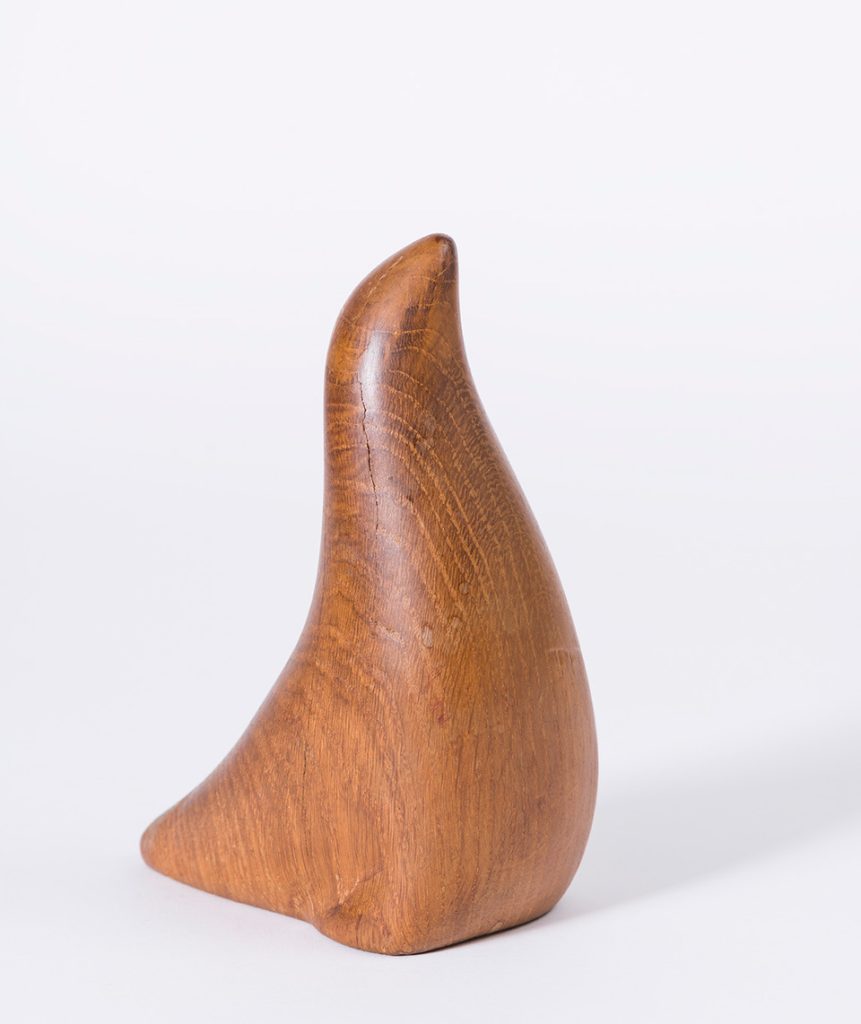
“All the sculptures begin with the wood”, said Maria Linde, meaning how she found or obtained it, collected as driftwood on long rambles on the nearby mudflats – like the bog oak – or acquired from neighbours and friends compelled to fell their fruit trees because of windthrow. Forms follow the wood’s own specifications and its grain; they make their appearance as organic vegetative motifs or as animal figurations discerned in the wood, such as birds or cats. Maria Linde’s work thus takes its place in a multifaceted tradition of animal sculpture which began in Germany with August Gaul (1869–1921) in the nineteenth century and reached a peak with Renée Sintenis (1888–1965) in Berlin and Ewald Mataré (1887–1965) in the Rhineland in the twentieth.
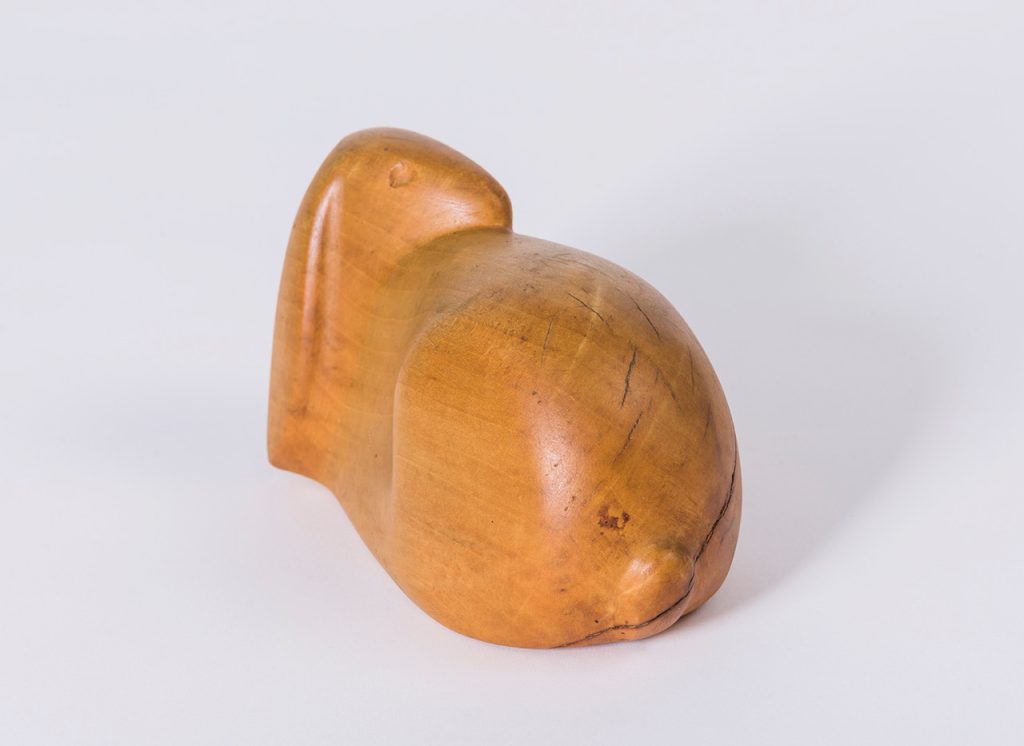
Maria Linde’s individual works are rarely dated, and neither do they have official titles, but rather auxiliary designations in quotation marks, as in a catalogue by the edition galerie lüth in Halebüll from 1990, the only one to appear during Linde’s lifetime. The extensive publication Ruth Maria Linde-Heiliger – Holzskulpturen, from 1997, edited by Maria Linde’s children in homage to their mother, attempts to place its illustrations in chronological order. The title of our exhibition is founded in the resulting “timelessness”, and it is the theme of her autobiographical statements in this publication. So the sculptures are doubly timeless – in their uncertain dating and in their abstraction, whose aesthetic impact is still relevant.
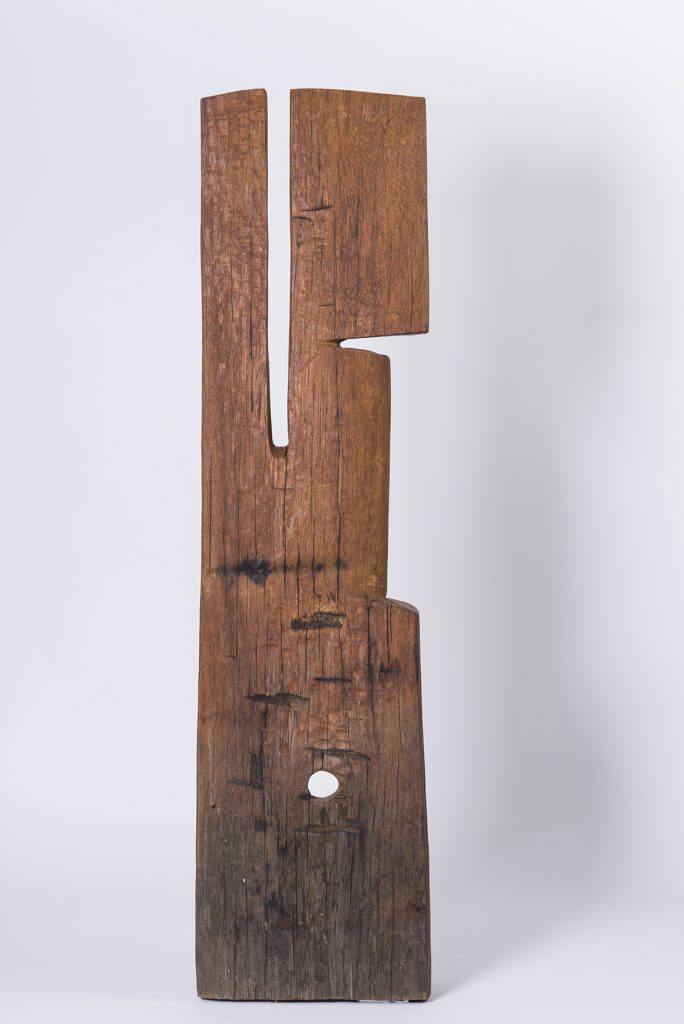
The subtitle describes Maria Linde’s intention in creating sculptures. She herself called her works “sculptures for living spaces” because it was her opinion that they could only take effect in a protected interior, and because she wanted to live with them. This idea of shaping one’s personal living space presumably goes back to her training with Johannes Itten, who continued the Bauhaus idea as a matter of course at the School of Applied Art in Krefeld when the Bauhaus in Dessau closed in 1933. Its essence had always been to conceive the everyday world and life in a designed environment as a unity, to bring function and aesthetics together in a consciously lived life. This was Ruth Maria Linde-Heiliger’s achievement. She died in Eiderstedt on 14 June 1996. In thirty years of seclusion on the west coast of Schleswig-Holstein, in the protection of the dikes, she produced an oeuvre that this exhibition rediscovers and re-evaluates after another thirty years.
Exhibition catalogue
A catalogue published by Hatje Cantz accompanies the exhibition.
Support
With support from the “Mehr Kultur” programme of Berliner Sparkasse